
Remount RoundupIssue 22
Tesla just added fuel to ARK's 8 million robotaxi forecast
ARK's new model puts about 8.1 million robotaxis on Tesla's network by 2031. On Wednesday's call, Tesla put target dates on the first steps. Here's how I read it.
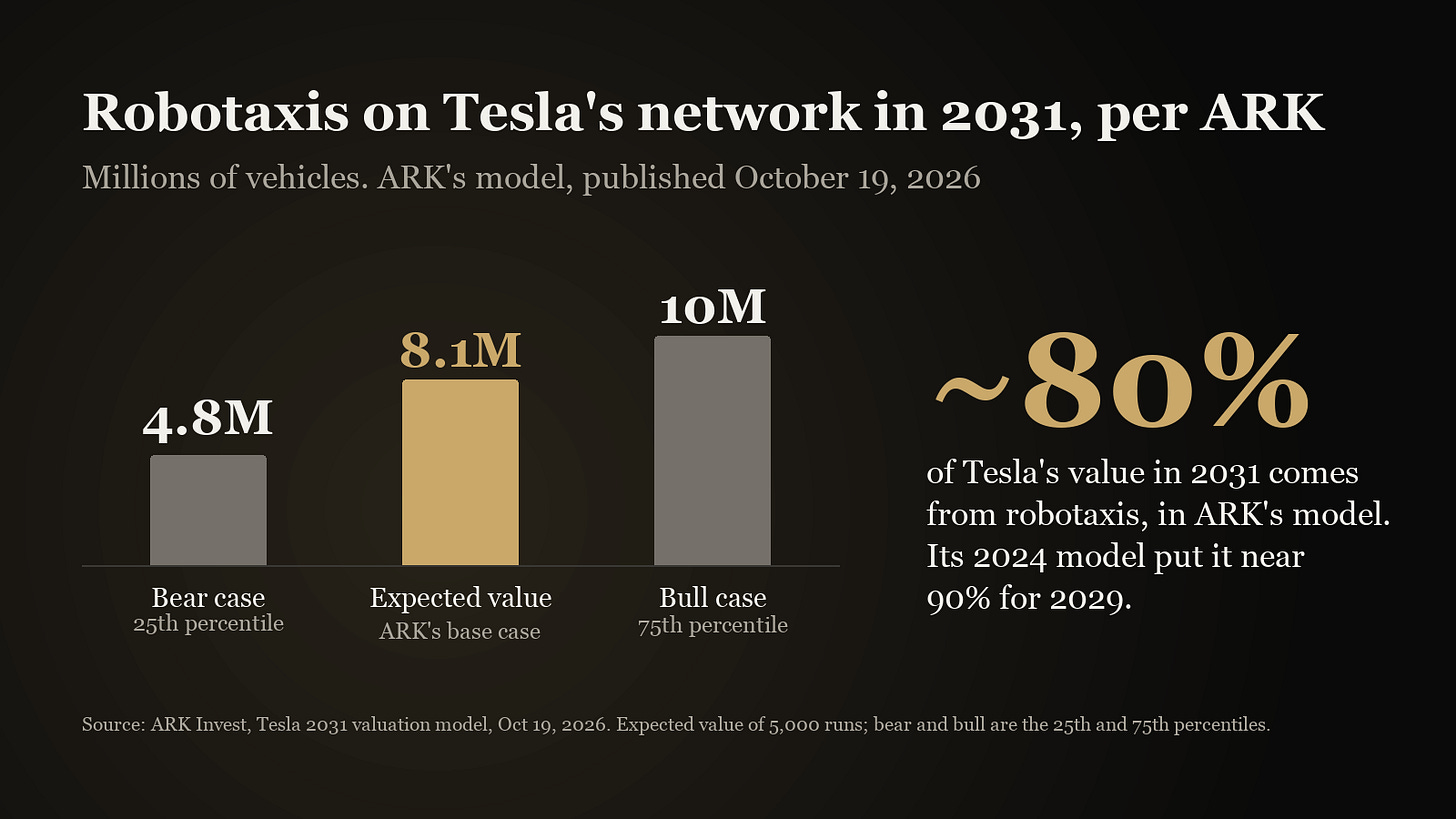
ARK Invest expects about 8.1 million robotaxis to be running on Tesla’s network by 2031. Even its bear case has about 4.8 million.
That’s independent research. ARK isn’t Tesla, and it isn’t us. It published its new Tesla model on Monday, October 19, and put the whole workbook on GitHub, so you can check every one of its 32 inputs yourself. ARK puts robotaxis at about 80% of Tesla’s enterprise value in 2031 and expects ride-hail to bring Tesla about $753 billion of revenue that year.
For the Cybercab, the number that jumped out at me is cost. ARK’s research says that in 2031, with both at scale and at equal utilization, a Cybercab will cost about 40% less per mile to operate than Waymo’s next-generation robotaxi. ARK argues that robotaxis can run profitably below today’s ride-hail prices, which would put on-demand rides within reach of far more people. You can argue with any of ARK’s inputs, and I’ll get to where we differ. But start from ARK’s bear case and its research still points to a massive opportunity.
Two days later, Tesla added fuel to the fire on Wednesday’s Q3 earnings call. Some of that was pace. Tesla’s Q3 Update, out the same afternoon, says Cybercabs have carried riders in Austin since September 3, and that its Robotaxi service reached nearly two million cumulative unsupervised miles by the end of September, eightfold over the quarter. Asked about taking Cybercab beyond Austin, Ashok Elluswamy, Tesla’s VP of AI software, said “next month we’ll be launching in Dallas.”
If you skimmed the coverage, you may have missed the comments about who gets the cars. Lars Moravy, Tesla’s VP of vehicle engineering, said Tesla is “trying to get Cybercabs to customers by the end of this year.” For now, he said, every Cybercab coming off the Texas line goes into Tesla’s own Robotaxi fleet. Tesla will “start small“ and scale from there, he added. If Tesla gets there, that changes before the year is out.
Elluswamy’s other answer goes a step further. “We suspect somewhere around Q2 next year is when we can turn on some of the first customer vehicles to be part of the robotaxi fleet,” he said. That’s Tesla’s target for the second quarter of 2027. His example was a customer’s Model Y running the same software as the Cybercab, inside Tesla’s geofences and fleet management. As I read it, customer cars can mean a fleet’s cars too, not only one owner’s Model Y. Customer cars are also the engine of ARK’s forecast, which grows Tesla’s robotaxi fleet out of Teslas that people and companies buy, with a rising share joining the network each year.
Elon Musk’s comment, which came right after Moravy’s answer on customer deliveries, was the controversial one. He said “the vast majority of the Cybercab stuff will be essentially Tesla-owned and transport-as-a-service.” Read literally, Tesla would own most Cybercabs. I suspect he meant that most Cybercabs will be part of Tesla’s Robotaxi network and run only on it, whether or not Tesla owns them. That reading sits close to ARK’s model, which caps the robotaxis Tesla owns itself at a few thousand and has partners running the rest on Tesla’s network. ARK built that before anyone heard Wednesday’s call.
In any case, all of this makes me think we’re on the right path at Remount. We started the company so everyday people could own robotaxis that run on Tesla’s network, and on Wednesday Tesla’s executives talked about autonomous cars in customer hands and gave dates for it. We’re still pre-launch with registrations open. If Tesla hits the dates it gave, opportunities for owners outside Tesla could start to appear as early as the end of this year. Those dates are Tesla’s targets, not promises from Tesla or from us.
ARK’s model and ours differ on some key points. ARK is modeling all of Tesla. Our modeler follows one car, counting each cost line by line over a five-year window with no value left in the car at the end, and it assumes $30,000 for the vehicle where ARK uses $25,000 as the average price of a Cybercab. Tesla hasn’t published a Cybercab price or any terms for owners, so those are assumptions on both sides. On the size and scope of this opportunity, though, Monday’s model and Wednesday’s call both back up our thinking.
Dallas is due first, next month by Elluswamy’s account. The date I’m watching is Tesla’s year-end goal for customer Cybercabs, about ten weeks from now.
Jonas
Autonomy roundup: the week’s evidence
Optimus production began in Fremont, Tesla’s Q3 Update says. Tesla calls the robots coming off its high-volume lines there its “first production-quality bots” (page 6). Musk said on the call that reaching 20,000 robots a week will probably take at least a year, with deliveries to outside companies targeted for around the end of 2027. On the Cybercab side, CFO Vaibhav Taneja said Tesla plans to bring Cybercab to “some other cities before the end of this year,” and the deck still lists more than 125,000 a year of installed Cybercab capacity in Texas, the same as in July, which Tesla notes is not its current production rate (page 6). Revenue was $28.05 billion, flat from a year earlier, and adjusted EPS was 48 cents, against the $27.9 billion and 43 cents expected by analysts polled by LSEG, per CNBC. Tesla Q3 2026 Update, Oct 21 · Drive Tesla Canada, Oct 21 · TeslaNorth, Oct 21 · CNBC, Oct 21
Tesla stretched Austin robotaxi hours to midnight. Riders in Austin can now book from 6am to midnight, according to a Robotaxi app notification shared on X and reported on October 17. That’s the second extension in about two weeks, after the move to 11pm earlier in October. Elluswamy has said the next version of its driving software, FSD v15, will unlock round-the-clock Robotaxi operations; a fleet-wide rollout to Robotaxi vehicles is reportedly targeted for this month. That timing is a target. Not a Tesla App, Oct 17 · TeslaNorth, Oct 3
Texas now has 349 Cybercabs registered. State registration data compiled by the Texas AV Tracker and reported on October 15 showed 349 Cybercabs and 420 Model Y robotaxis registered to Tesla, after a record batch of 150 Cybercabs the week before. The first Cybercabs were registered on August 31. A registration shows a car Tesla has put on Texas records, not that it is carrying riders. EVwire, Oct 15
Reader question: what did you make of Musk’s line that “the vast majority” of Cybercabs will be “essentially Tesla-owned”? Reply and tell me how you read it.
See how the ownership side of a Cybercab works, line by line: register at remount.co and we’ll send you the dataroom link.
This newsletter is general information, not an offer to sell or a solicitation of an offer to buy any security. Any offering Remount conducts is made only to verified accredited investors through definitive documents under Rule 506(c). Forward-looking statements are estimates, not promises.