
Remount RoundupIssue 20
In 2016, I predicted The Uberpod. I think Tesla is going to build it.
In 2016 I wrote a series of predictions for the decade ahead. Most of it showed up early. What I missed was who owns the machines.

Ten years ago this week, on September 28, 2016, I published a post on Medium called The Uberpod Manifesto. I was trying to picture daily life for a college-educated 25-year-old in 2030, and I ended with a call to build the lifestyle experience that person would want. Rereading it with four years left on the clock, parts of it read like a forecast and parts are still sci-fi. Here is my scorecard.
What I got right
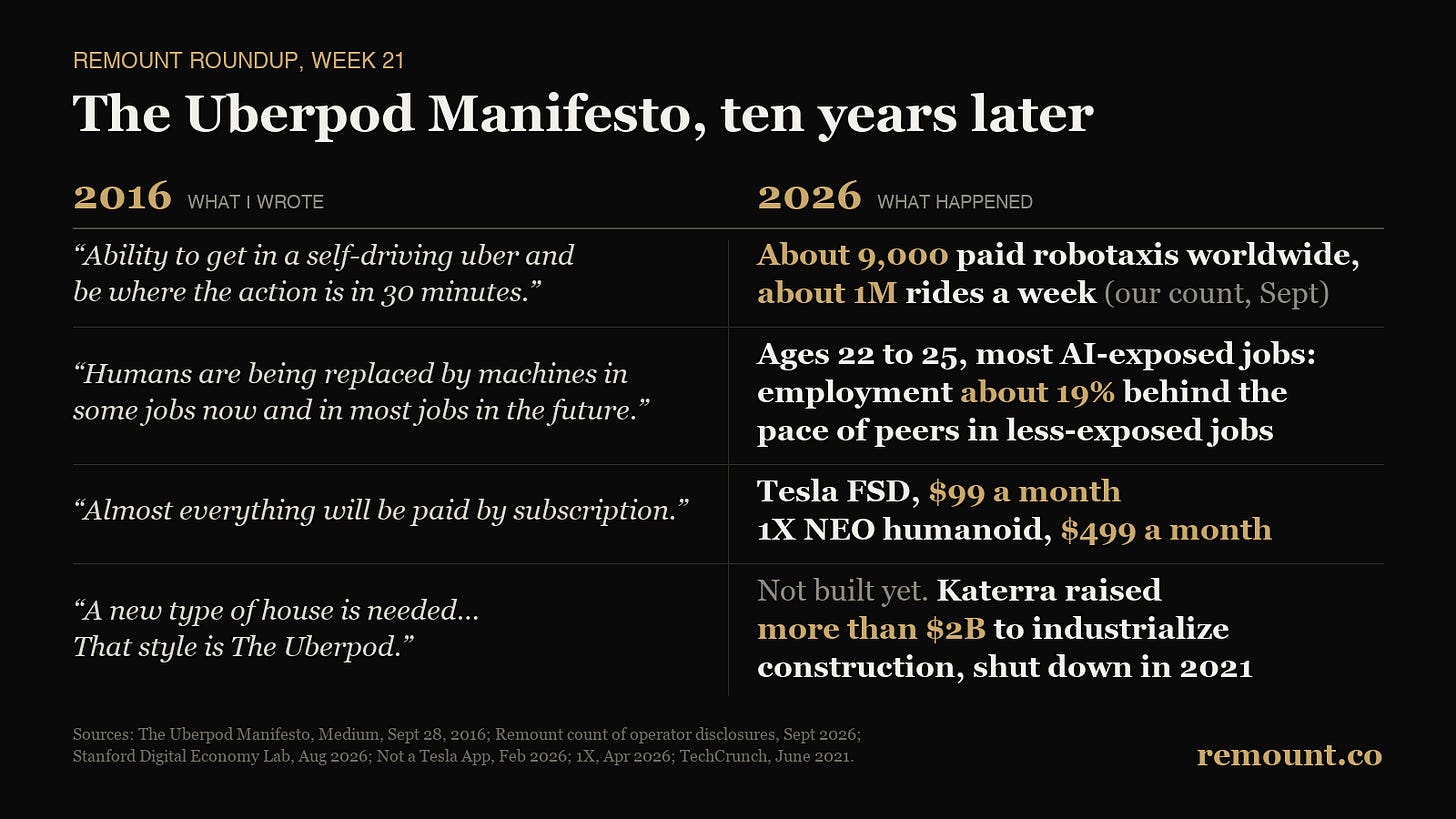
One line in that post matters more to me today than everything else in it: "Ability to get in a self-driving uber and be where the action is in 30 minutes." In 2016 that sounded like science fiction, but I had followed the DARPA Grand Challenges and was already doing my own research on lidar and self-driving investment opportunities.
I'll count that one as a big W with four years to go. By our count, about nine thousand robotaxis carried paying riders worldwide in September. Waymos seem to be everywhere, and by 2030 Cybercabs legitimately will be.
I wrote that machines would replace people in some jobs by now and in most jobs later. The first half stopped being a prediction. Stanford researchers found in August that employment for workers aged 22 to 25 in the jobs most exposed to AI now sits about 19 percent below where it would be if it had kept pace with their peers in less-exposed jobs. Experienced workers show no comparable gap. My 25-year-old is the person feeling it first.
I wrote that almost everything would be paid for by subscription. In February Tesla stopped selling Full Self-Driving outright and now rents it for $99 a month. 1X will put its NEO humanoid in your home for $499 a month. I also wrote that fixing the toilet and maintaining the car would become 20th century chores. Last month Figure sent its humanoid into 30 Bay Area homes it had never seen to tidy living rooms, fold towels and make beds. And just last week I saw a Tesla worker wearing a full Optimus data collection suit and headset working on cars in my local Tesla dealership. I can't claim that W yet, but give it a few years.
I was too dark about terrorism, but I did flag the risk of a pandemic. It arrived four years later and brought the retreat into digital life I described.
Two of the background trends held up as well. The US fertility rate fell to a record low of 1.57 in 2025, and about a quarter of paid workdays in this country now happen at home.
What I got wrong (so far)
I was too optimistic on immersive virtual reality. Apple's Vision Pro didn't stick the landing, though Meta may still get us there by 2030. And I was, and still am, ahead of the curve on radical life extension. GLP-1s, personalized cancer treatments and AI-driven health informatics are real gains, but we need another decade of AI-driven wins before we reach longevity escape velocity.
My biggest wrong call was the title itself. The Uberpod hasn't been built yet. Factory-built housing that you rent by the month and move with you was much harder than I thought. Katerra raised more than $2 billion, much of it from SoftBank, to industrialize construction and shut down in 2021. Housing politics did not get skipped. They got harder. Squint a little, though, and you can see it coming. Vanlife is more popular than ever with millennials and Gen Z, and Tesla pitches its Robovan as a self-driving mass-transit vehicle. I'd argue it's really an Uberpod on wheels: your home, office and ride, wherever you want or need to be. I think it will be on (and off) the road by 2030.
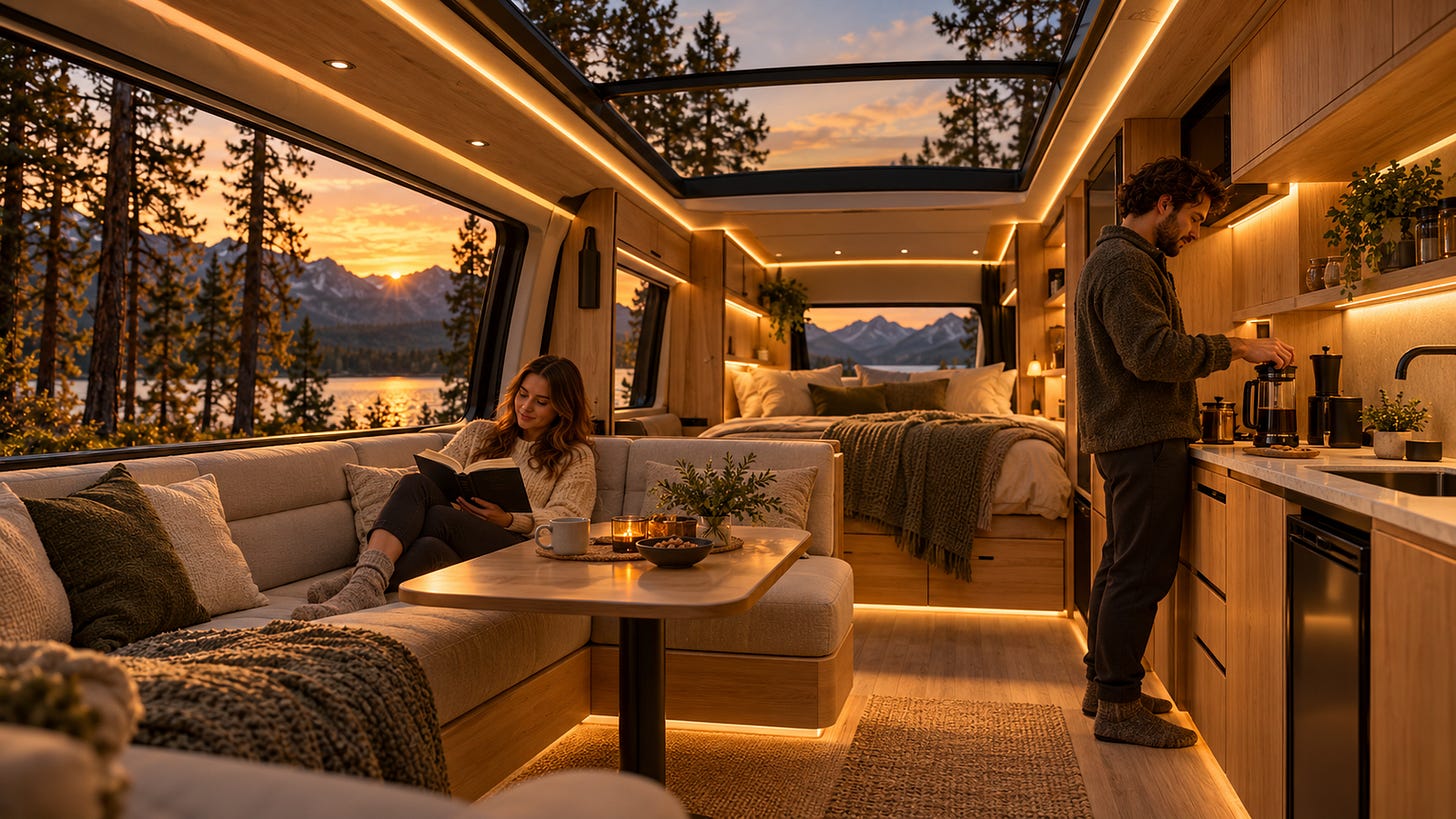
Tesla’s Robovan imagined as a comfy Uberpod
What I missed
I pictured my 25-year-old renting their ride, their robot and their home, and I never asked who owns the things being rented. When the driver is software and the housekeeper is a robot, the income those machines produce goes to whoever holds the title. In 2016 that was going to be a handful of companies by default. It still is. Every robotaxi on the road today sits on a corporate balance sheet or in a fund.
Why this matters
On balance, my 2016 trend spotting lines up with where we're headed. Back then I didn't appreciate ownership the way I do today. That gap is why I started Remount. If machines are going to do more of the work, more people should own a piece of the machines, and not only pay for their services. A robotaxi earns money every hour it carries riders, and a humanoid on a lease earns while it works. Those are income-producing assets, and they can be owned by people who are not the companies that built them.
I closed the 2016 post by comparing the Uberpod to Tesla's first Roadster. The Uberpod hasn't been built yet. The self-driving Uber has. This time I'd like the ownership part to get built too.
Jonas
We updated the modeler
Our depot work this fall, from the September 25 Roundup through the cost modeling since, told us the depot line in our Cybercab model was too light. A depot that charges, cleans, parks and does light service on a Cybercab will need to bill about $1,000 a car a month, and the model was carrying about $424. The modeler now uses $1,000, with energy billed at cost, so one Cybercab's modeled operating cost moves from $13,611 to $18,132 a year, and the owner's modeled payout comes down with it. If you want to see the new numbers line by line, sign in at remount.co/dataroom, or register at remount.co and we'll email you a link.
Autonomy roundup: the week's evidence
Lyft built the garage for someone else's robotaxis. On October 2 Lyft said its Flexdrive unit opened an 80,000-square-foot depot in Nashville with dozens of fast chargers, built to support hundreds of autonomous vehicles, plus bays for high-voltage repairs. Waymo's cars move in on October 12. The software is Waymo's and the building is Lyft's, which is a useful picture of how many hands the work of a robotaxi passes through. Lyft
California set the rules for when a robotaxi gets in the way. Governor Newsom signed Senate Bill 1246, reported October 1. Operators will face fines when a robotaxi blocks first responders for more than 30 minutes, remote drivers must be US-based with US licenses, and companies must send a local technician to accidents and obstructions. It takes effect in July 2028. Every one of those obligations is a cost of operating the fleet, and somebody's books carry it. TechCrunch
A humanoid maker went to Wall Street. Agility Robotics held its first investor day in New York on October 6, ahead of its merger with Churchill Capital Corp XI, which it expects to close in the fourth quarter and list as AGLT on Nasdaq. Agility says it has more than $300 million in multi-year orders for Digit 5, counted as of May and tied to contract milestones, not current revenue. That is one way for the public to own a piece of the robot business: the company that builds the machines. Agility Robotics via Business Wire
Reader question: what did you predict ten years ago that came true early, or never came at all? Reply and tell me. I'll share the best ones next week.
See how the ownership side of a Cybercab works, line by line: register at remount.co and we'll send you the dataroom link.
This newsletter is general information, not an offer to sell or a solicitation of an offer to buy any security. Any offering Remount conducts is made only to verified accredited investors through definitive documents under Rule 506(c). Forward-looking statements are estimates, not promises.